Sense sits on your machine, has no learning curve, and isn't for you. It's for your AI.
A codebase is structure, not just text. The graph of what calls what, what breaks what, how the team writes. It's real, it's knowable, and it belongs on your machine. Everything else about Sense, local, read-only, four tools, no account, follows from that.
"Who calls this? What implements that?"
Your AI navigates callers, callees, inheritance chains, and test coverage from any symbol, without reading dozens of files to piece the picture together.
"Find by meaning, not just by string."
Your AI finds relevant code by concept, not just grep patterns. Hybrid keyword + semantic search with bundled embeddings. No API keys, no network.
"What breaks if I change this?"
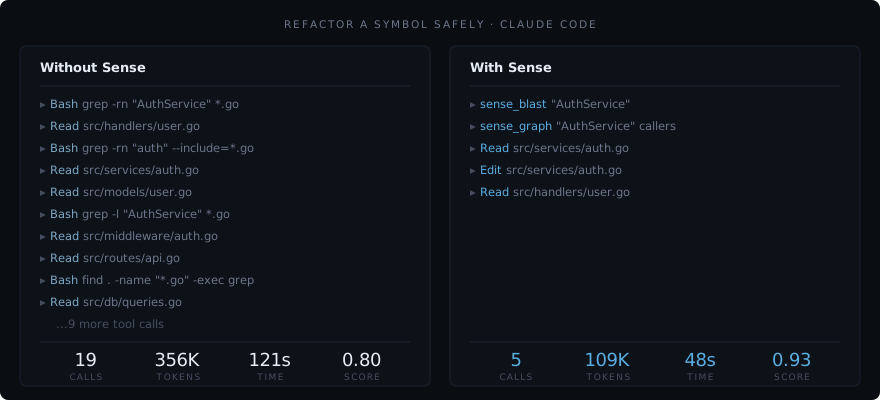
Before your AI modifies a symbol, it traces direct and transitive callers to know the full surface area of the change. Fewer surprises, fewer broken builds.
"How does this codebase do things?"
Your AI doesn't just write correct code. It writes code that matches how your team writes code. Sense detects patterns in naming, error handling, test structure, and architecture. Derived from the code, not configured.
Measured across 7 real-world codebases (Discourse, Flask, Next.js, Axum, Gin, Javalin, Maket, and a private e-commerce repo). Same correctness, dramatically less work. Full methodology and raw data: bench/
Sense was also run head-to-head against Serena, Probe, and GitNexus, plus a no-MCP grep baseline. Two of the four MCP servers scored below plain grep. See the full leaderboard →
Structural understanding is the product. Measurable efficiency is the proof.
Single binary, ~40 MB. macOS and Linux (Windows with WSL). No dependencies. No internet required past install. Everything runs locally, your code never leaves your machine.
One command indexes your codebase and configures your AI tools. Tree-sitter for structure, ONNX embeddings for meaning. Generates a cold-start summary so your AI knows the shape of the project at session start. Incremental on every run.
You don't type commands. Your AI picks which tools to call, chains them, and reasons over the results.
Your AI stops guessing about your codebase structure. It stops reading 30 files to answer "who calls this?" It stops hallucinating dependencies. It stops writing code that doesn't match how your team writes code. Not because the model got better, because it now has the structural understanding a senior engineer carries in their head.
Your AI reasons over actual structure instead of pattern-matching file contents, so it makes fewer wrong assumptions about what connects to what.
The graph rebuilds from your code automatically. No ontology to maintain, no config to tune.
Sense observes the codebase. It never modifies it. Safe to install, safe to leave running, safe to connect to any AI tool.
You don't think "Sense answered that." You think "my AI just got better."
Symbol graph, semantic search, blast radius, convention detection. Sense does these cleanly and resists the gravity toward “do everything.”
Your code, your data, never leaves it. No account, no telemetry, no tier.
Sense is read-only by design. It observes your codebase but never modifies it. Your editor and your tools stay in control. Read-only is the identity, not a limitation.
Structural understanding is the product. Measurable efficiency is the proof. If LLM costs dropped to zero tomorrow, Sense would still be valuable. Fewer tool calls means fewer wrong turns, not just lower bills.
Semantic search is one of four tools, not the product. The product is structural understanding that your AI reasons over.
Four tools is a choice, not a constraint. Your AI doesn't need 102 tools to choose from. It needs a few that work.
No API keys. No Ollama. No Docker. No Python. The moment Sense requires an external dependency, it loses its clearest advantage.
You never open a TUI, never type a command, never read Sense output. You notice it in the absence of frustration. Faster answers, fewer wrong turns, code that matches your conventions.